


An investor bought an apartment while it was still in the foundation phase of a new building on New Boulevard, waited a year and a half for it to be completed—and six months after moving in, discovered a crack running the entire length of the bedroom wall. The reason is simple: the contractor skimped on rebar, and there was no one to check it. That’s how people lose money—not because of a poor design, but because of a lack of oversight during the construction phase.
Designer supervision and technical supervision are two different but mandatory mechanisms for protecting investors. The former ensures that construction follows the plans, while the latter ensures that construction is carried out to a high standard, on time, and without cutting corners on materials. In this article, we’ll explain what design supervision is and how it differs from technical supervision, who is required to visit your construction site, what documents must be presented upon request, and how much this protection will cost in 2026.
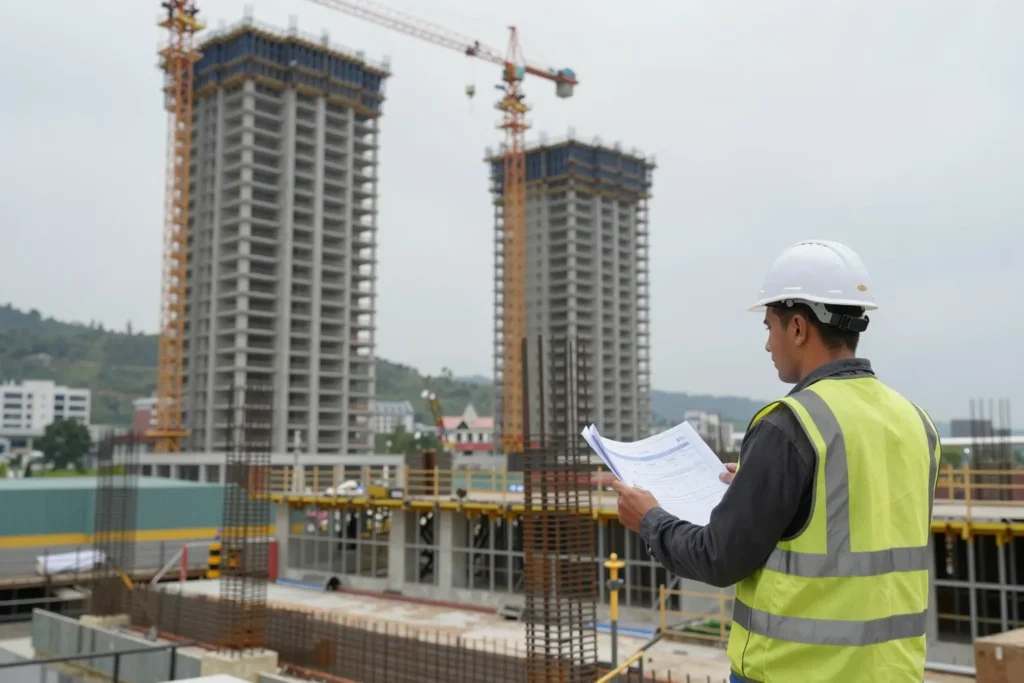
What Are Design Supervision and Technical Supervision: Definitions and Scope of Liability
Design supervision is the process of verifying that construction complies with the approved design documentation. It is carried out by the project designer or the design firm, and the procedure in Russian practice is described in SP 246.1325800.2016. Each visit by a specialist is recorded in the design supervision log—including the date, a description of any deviations, and a reference to the relevant section of the design.
Technical supervision involves monitoring the quality of materials, construction methods, schedules, and budgets on behalf of the client. It is carried out by a site foreman, a technical supervision engineer, or an independent company, with SP 48.13330.2011 serving as the primary guideline.
The Difference in Simple Terms
Design supervision answers the question, “Are we building what was designed?” Technical supervision answers the question, “Are we building to a high standard and on schedule?”
| Criterion | Author’s supervision | Technical supervision |
|---|---|---|
| Object of control | Compliance with the project | Quality of materials and technologies |
| Who performs | Project author, Chief Engineer | Foreman, PTO engineer, independent company |
| Periodicity | According to the visiting schedule | Every day on site |
| Document | Author’s supervision journal | General Work Log, KS-2 Acts |
| Benchmark standard | SP 246.1325800.2016 | SP 48.13330.2011 |
In Georgia, SNiP and SP do not have official legal force—the country has its own construction legislation, and requirements for on-site supervision are governed by local regulations on building permits. In practice, however, design and construction teams in Batumi use Russian standards as a generally accepted benchmark for quality.
There is also a regional reason for stricter regulatory oversight: Batumi’s subtropical climate brings over 2,400 mm of precipitation per year, and the area is classified as seismically active—7–8 on the MSK-64 scale. Under such conditions, defects in waterproofing and reinforcement become apparent more quickly than in an average region.
Who oversees the construction site: the chief engineer, the foreman, the construction engineer, and the surveyor
A team of specialists oversees the quality of construction in Batumi, with each member having their own area of responsibility.
- The Chief Project Engineer (CPE) coordinates design supervision, approves material substitutions, authorizes deviations from the design, and is responsible to the client for design decisions.
- The foreman is a key link in the technical supervision process on site. He oversees the daily sequence of work, issues instructions to crew leaders, and maintains a general work log.
- Construction Engineer — reviews construction drawings, certificates of concealed work, survey plans, and material certificates.
- Surveyor — monitors the geometry of structures, layout axes, and elevation marks; checks survey as-built drawings before signing the completion certificates.
- Foreman — receives instructions from the site supervisor and is responsible for ensuring that the work crew directly complies with the technical requirements.
The same team of specialists also oversees the construction of a private home from the ground up—on challenging sites, such as those on a slope, the scope of supervision only increases. You can see examples of what this looks like in practice in Realux’s portfolio of completed projects.
How a foreman and engineer supervise a site: daily procedures
Technical supervision is not a one-time inspection, but a daily algorithm.
- Checking the layout and geometry of structures before starting the stage.
- Incoming inspection of materials—verification against certificates and specifications, and checking for the substitution of materials with cheaper alternatives.
- Control of the technological sequence of works.
- Interacting with the foreman – issuing orders during the shift.
- Acceptance of the stage and recording of the result in the general work log.
It is at this stage that attempts to cut corners at the client’s expense are most often detected—an unscrupulous contractor counts on the fact that minor substitutions of materials will go unnoticed.
If construction is already underway but technical supervision has not yet been established, it is advisable to initiate supervision immediately, rather than after the completion of the next phase: a specialist can conduct an audit of the work already completed based on available documentation and reports on concealed work to document the current condition of the project.
Supervision documentation: what documents are maintained at the facility and why are they needed?
Without a paper trail, no violation has legal force. Let’s examine the key documents.
| Document | Purpose | Who’s leading? |
|---|---|---|
| Author’s supervision journal | Date, description of the violation with a link to the project, deadline for rectification, signatures | Project author, Chief Engineer |
| General Work Log | All stages of construction, deviations from the schedule, regulations | Foreman |
| Certificate of Concealed Work | Verification of work prior to enclosing structures—foundation, rebar, waterproofing | Construction Engineer, Surveyor |
| Certificate of Completion (KS-2) | Scope and Cost of Construction Work Performed | Technical Supervision, Construction Engineer |
| Survey As-Built Plan | Drawing of Actual Axis Elevations and Heights | Surveyor |
As-built documentation is a comprehensive set of reports, diagrams, and protocols that are reviewed by the construction supervision engineer and the technical inspector before the project is handed over. The absence of any of these documents is a cause for concern, even if the construction site appears to be in good order.
Typical violations and their consequences
Five categories of violations are most frequently encountered at facilities in Batumi:
- Substitution of materials — replacing certified material with a cheaper or uncertified alternative.
- Deviations from geometry – displacement of axes, incorrect elevation marks.
- Failure to follow the proper procedure—shortening drying times, omitting waterproofing layers.
- Project errors that are only revealed on-site.
- Unauthorized changes without the approval of the Chief Project Engineer.
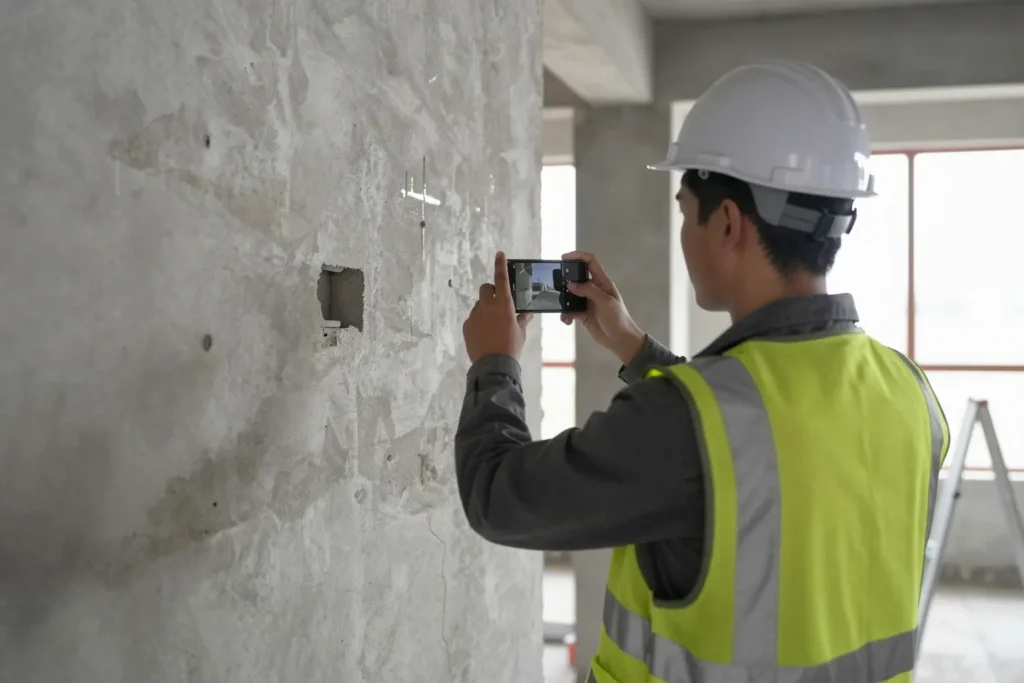
To document such incidents, photographs are taken—including the date, time, and a description—which gives the photograph legal validity as an attachment to the construction supervision log. After the violation is documented, the site supervisor or the chief construction inspector issues a corrective action order, which is forwarded to the foreman or directly to the contractor.
Troubleshooting procedure: from fixing to checking
Work with the identified violation is based on a clear algorithm:
- Recording the violation in the author’s supervision or general works log.
- Supplementing the recording with photographic evidence.
- Issuance of an order for rectification with an indication of the deadline.
- Notification of the contractor and, if necessary, the foreman.
- Post-expiration control check.
- Signing the report—either confirming that the violation has been corrected or noting a repeat violation, which will result in penalties.
If the contractor systematically fails to comply with the terms of the contract, the contract may be terminated—this should be specified in advance, during the stage of negotiating the terms.
How Much Does Property Management Cost in Batumi: A Comparison of Options and Where You Shouldn’t Skimp
The cost of technical supervision is typically calculated as a percentage of the construction estimate—roughly 3 to 7 percent—or as a fixed monthly rate. The exact figure depends on the area, the complexity of the project, and the topography of the site, so it’s best to request a quote tailored to the specific project. The client has three main options for organizing supervision.
| Option | Price | Scope of control | Risks |
|---|---|---|---|
| The developer’s full-time engineer | Average | Depends on the object loading | Conflict of interest with the contractor |
| Independent company | Above average | Complete, no conflict of interest | Requires a separate budget |
| Developer’s foreman | Below average | Limited | Combining roles reduces objectivity |
Cutting corners on supervision usually results in more expensive repairs to defects after the project is completed—cracks, leaks, and uneven geometry end up costing the client many times more than inspections during the construction phase. The cost of building a house in Batumi and where the budget goes—we’ve broken this down separately in an article on the overall cost structure of building on a slope.
How to choose a contractor for technical supervision: a checklist for developers and investors
Before entrusting quality control to a specific specialist or company, it’s worth checking the following six points:
- Qualifications and membership in relevant self-regulatory organizations.
- Work experience specifically in Batumi—taking into account the climate, seismic conditions, and local characteristics of new construction projects.
- A well-established team—a foreman, a construction engineer, and a surveyor.
- Transparent Document Workflow — Sample Logs and Records Prior to Signing the Contract.
- Legal Basis — The right of the technical supervisor to issue directives and block progression to the next stage without signed inspection reports.
- A portfolio of completed projects, with the option to contact previous clients.
Working without a contract with a technical supervision agency is a common risk: in this case, the instructions have no legal force, and photographic evidence of violations cannot be used as grounds for claims. If you need advice on organizing supervision at your site—whether you’re building a house from scratch or overseeing a construction project that’s already underway—you can reach out to the Realux team: we’ll help you determine which supervision option is best suited for your specific project.
