


Most plot buyers in Batumi discover the real cost of construction only after the deal is done — when it’s too late to change anything. A 150 m² house on a flat plot costs $120,000–180,000. The same house on a 20° slope — up to $250,000. The $70,000 difference doesn’t come out of thin air: it’s made up of the foundation, earthworks, engineering, and logistics that neither the developer nor the realtor warns you about in advance.
This article lays out the full structure of a 2026 estimate: from surveying and permits to final finishing. With real figures in GEL and $, tables by foundation and material type, and a separate breakdown of the hidden costs that eat up another 25–40% of the budget. If you’re planning to build a house in Batumi, read to the end — you’ll save on at least one line of the estimate.
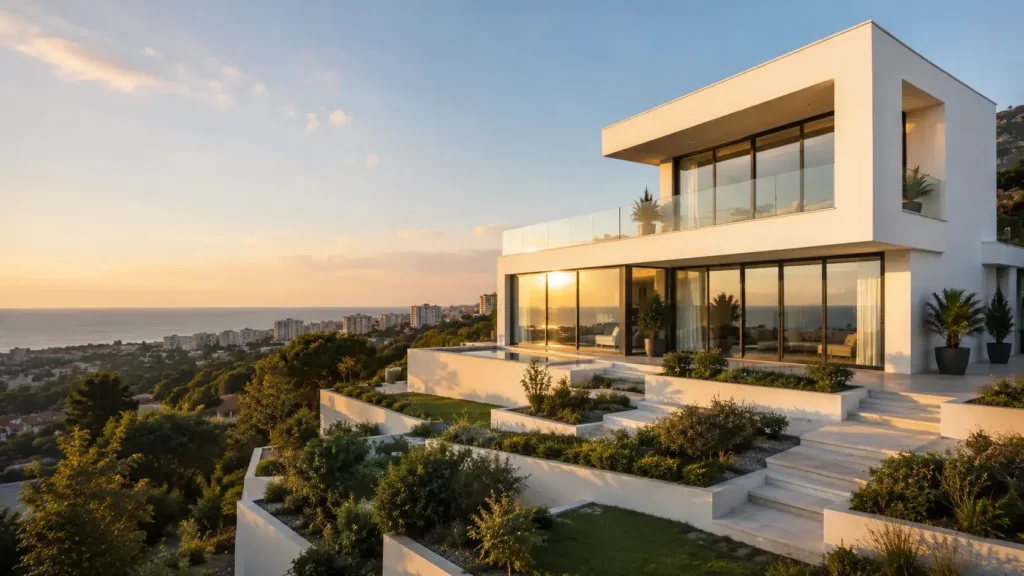
Design and permits: where the estimate begins
Design is the only stage where the slope of the plot starts affecting the budget before the first scoop of earth is moved. This is exactly where the difference between a $120,000 house and a $250,000 house is set — and exactly where most builders fail to notice it.
The first thing to do before developing the architectural design is to carry out a geodetic survey and geological investigations. A geodetic survey costs 800–1,200 GEL and records the exact plot boundaries, height differences, and slope angle. Geological investigations cost 500–800 GEL and determine the soil type, groundwater level, and the load-bearing capacity of the base. Both studies are mandatory for slopes over 10°: without them, the designer simply cannot calculate the foundation correctly.
An architectural design for a flat plot costs $15–25/m². For complex terrain — a slope of more than 15° — the price rises by 40–60%, because the designer has to develop non-standard structural solutions: a stepped foundation, retaining walls, terracing. For a 150 m² house, this means a difference of $2,250–3,750 on design alone.
A separate line item is the construction permit. Under Georgian law, building without a permit is prohibited: the fine is up to 5,000 GEL, and the court may also order demolition of the structure. The permit is issued by the Batumi municipality after the project documentation is submitted. The procedure takes 2–6 months. The state fee is 800–1,200 GEL, but the real costs — including support and additional approvals — reach 2,000–3,000 GEL.
Construction in Batumi is carried out according to Georgian building codes with mandatory compliance with seismic requirements — the city is in a seismic activity zone of magnitude 6–8. This means that a monolithic reinforced concrete frame, in one form or another, is present in every house regardless of the main wall material.
| Design stage | Price | Mandatory at slopes >10° |
|---|---|---|
| Geodesy | 800–1200 GEL | Necessarily |
| Geological surveys | 500–800 GEL | Necessarily |
| Architectural project (flat area) | 15–25 $/m² | — |
| Architectural project (slope >15°) | 21–40 $/m² | Markup +40–60% |
| Building permit | 800–1200 GEL (duty) | Mandatory by law |
| Full package of approvals | 2000–3000 GEL | Necessarily |
Read more about the company’s design process and stages on our turnkey home construction page.
Foundation and excavation work: the most vulnerable budget item on a slope
The foundation is where the slope of the plot hits the budget the hardest. On a flat plot, the foundation for a 150 m² house costs around 18,000 GEL. On a 20° slope, the same structure costs up to 36,000 GEL — twice as much. And that’s before the walls, roof, and finishing.
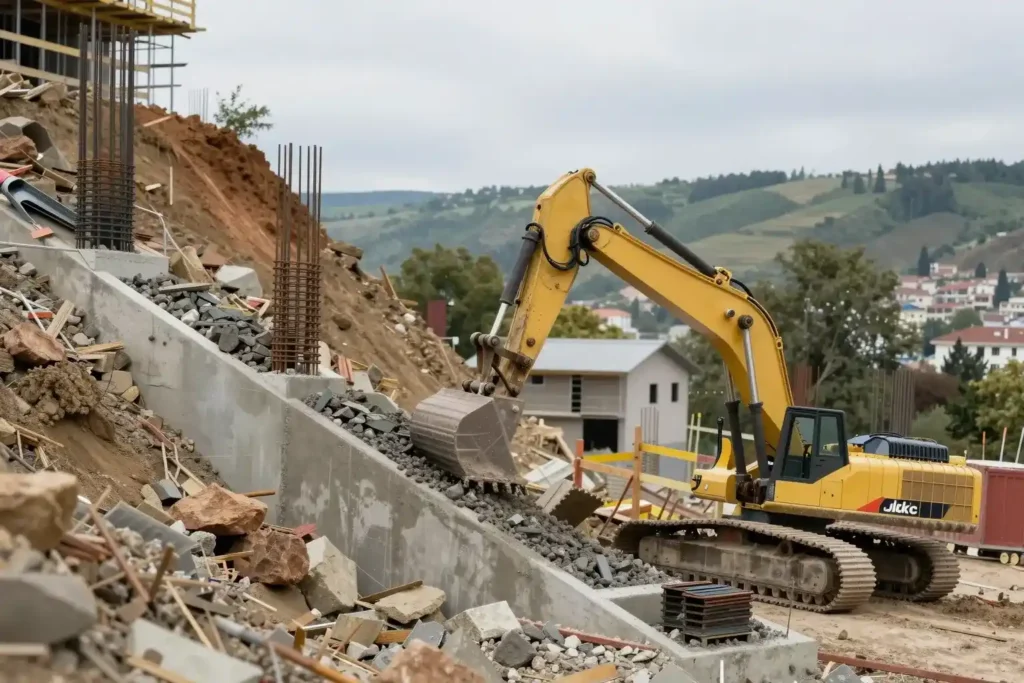
The choice of foundation type depends directly on the slope angle. For slopes up to 10°, a standard strip foundation is suitable — the cheapest option. For slopes of 10–25°, a stepped strip foundation is used: it follows the contour of the plot, which reduces the volume of earthworks but requires more complex reinforcement. For slopes over 15°, a pile frame is often chosen — it’s 20–40% more expensive than a strip foundation, but it’s the only reliable option on the unstable soils of Batumi’s coastal zone.
Earthworks on a 20° slope cost 70% more than the standard. The reason is the increased volume of soil excavation, the need to remove or redistribute it across the plot, and the rental of heavy machinery that is harder to operate on a sloped surface.
For slopes over 20°, retaining walls become a mandatory element: without them, the soil will press on the foundation, and during heavy downpours — typical of Batumi’s subtropical climate — ground movement is possible. The cost of retaining walls is 200–400 GEL/m² depending on the material and height of the structure. An alternative for slopes up to 25° is geogrids for slope reinforcement (45–70 GEL/m²): they are 30% cheaper than retaining walls but are not suitable for all soil types.
Terracing the plot adds from 150 GEL/m² to the estimate, but it significantly reduces the load on the foundation and simplifies subsequent landscaping.
| Slope angle | Foundation type | Price | Surcharge to the standard |
|---|---|---|---|
| Up to 10° | Ribbon | 150–160 GEL/m³ | — |
| 10–25° | Tape step | 150–180 GEL/m³ | +20–30% |
| More than 15° | Pile frame | 180–220 GEL/m³ | +30–40% |
| More than 20° | Any + retaining walls | 200–400 GEL/m² (walls) | +70% to excavation work |
House frame: materials and increased cost due to terrain
The building shell is the main cost item: $500–900/m² depending on the material and number of storeys. On a slope, another 5–10% is added for logistics: delivering materials to a sloped plot is harder, requires additional machinery, and takes more time. For a single batch of materials, that’s an extra 200–500 GEL.
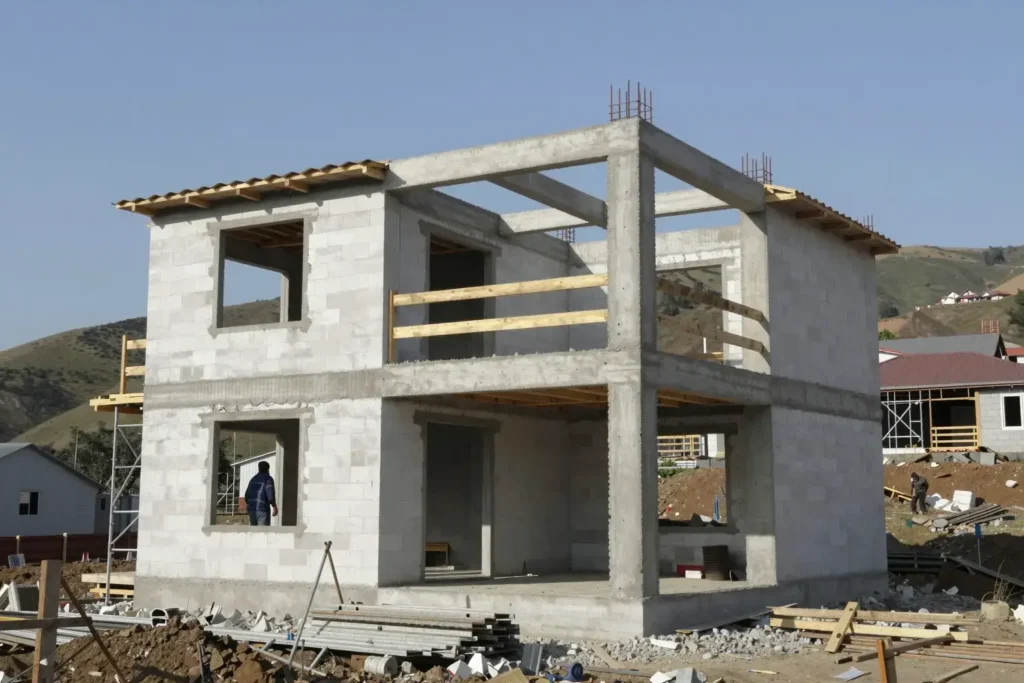
Three main wall materials are used in Batumi. Aerated concrete blocks are the most common choice: they cost 45–55 GEL/m³, retain heat well, and are quick to install. Aerated concrete is 25% cheaper than brick and easier to work with. Ceramic brick costs 0.35–0.45 GEL/unit, lasts longer, and copes better with the humidity of the subtropical climate, but it’s more expensive and takes more time to lay. Pumice blocks are a local material, affordable and well adapted to regional conditions.
Regardless of the chosen wall material, a monolithic reinforced concrete frame is mandatory — it’s a requirement of Georgian building codes for seismically active zones. The monolithic frame costs 80–120 GEL/m³ and increases the overall shell budget, but it provides stability for earthquakes up to magnitude 8 — which is precisely the design load adopted for Batumi.
The roof is a separate line in the estimate: 90–150 GEL/m². On a plot with complex terrain, the roof configuration becomes more complicated, with additional valleys and hips — pushing the cost to the upper end of the range.
| Material | Price | Thermal insulation | Seismic resistance | Note |
|---|---|---|---|---|
| Aerated concrete blocks | 45–55 GEL/m³ | High | Medium (frame needed) | The main choice for Batumi |
| Ceramic brick | 0.35–0.45 GEL/piece | Average | High (with frame) | More durable, 25% more expensive |
| Pumice blocks | Local production | Average | Medium (frame needed) | Affordable price, popular in the region |
| Monolithic reinforced concrete frame | 80–120 GEL/m³ | — | Maximum | Mandatory according to Georgian regulations |
| Delivery to the slope | +200–500 GEL/batch | — | — | Markup of +5–10% on materials |
Engineering communications: a complete set and a surcharge for relief
Utility systems on a slope cost 35–40% more than on a flat plot. The full package — electricity, water supply, sewerage, gas, heating, ventilation — costs 8,000–15,000 GEL. On a slope, the lower end of this range is practically unattainable.
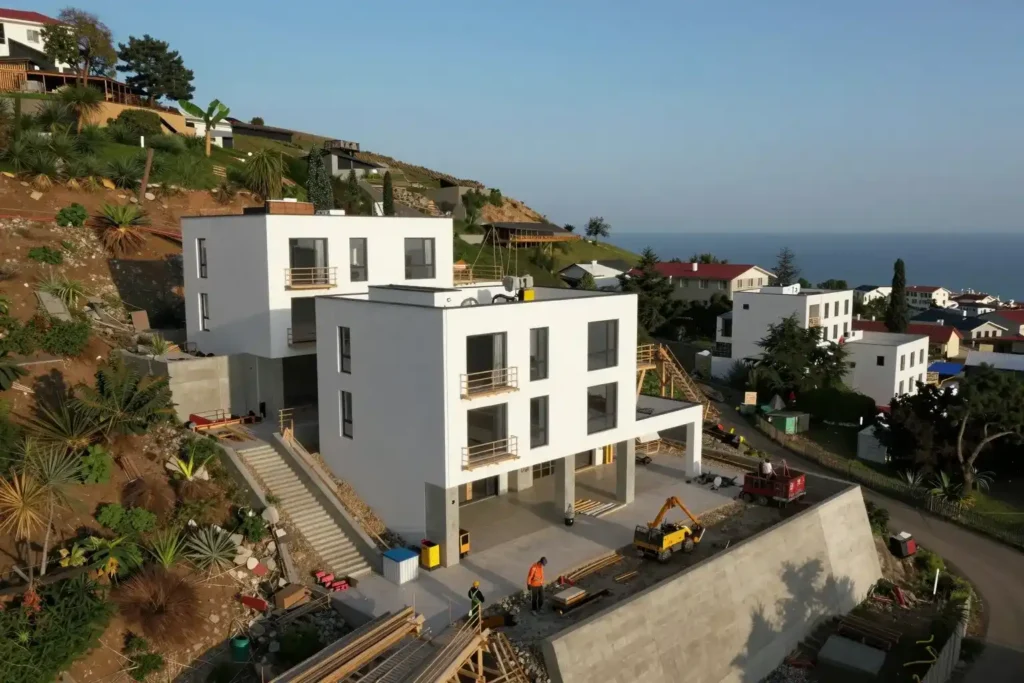
The reason for the higher cost lies in the physics of the terrain. Utility trenches on a slope are longer and harder to dig and reinforce. Gravity-fed sewerage requires the correct pipe gradient, which on a sloped plot forces you either to bury the lines deeper or install pumping equipment. Heating lines become longer due to the changes in level.
A septic system on a flat plot costs 2,200–2,500 GEL. On a slope, the same system costs 3,200–3,500 GEL: terraced installation, a pump for forced effluent feed, and reinforced waterproofing of the tanks — an extra 1,000–1,300 GEL.
A drainage system on a slope is not just desirable — it’s mandatory. Batumi receives up to 2,500 mm of precipitation per year, and without storm-water drainage the foundation will start getting wet in the very first season. The cost of drainage is 25–35 GEL/linear metre.
A gas boiler room on a flat plot costs 2,500–4,000 GEL. On a slope, the connection to the main gas pipeline becomes longer, adding another 1,000–2,000 GEL to the estimate.
| System | Standard (flat area) | On the slope | Difference |
|---|---|---|---|
| Electricity + wiring | 1500–2500 GEL | 1800–3000 GEL | +20–25% |
| Water supply | 1200–2000 GEL | 1500–2500 GEL | +25% |
| Sewage (septic tank) | 2200–2500 GEL | 3200–3500 GEL | +40–45% |
| Gas boiler room | 2500–4000 GEL | 3500–6000 GEL | +40–50% |
| Drainage system | Not required | 25–35 GEL/running meter | New article |
| Total set | 8,000–11,000 GEL | 11,000–15,000 GEL | +35–40% |
Finishing work: from rough to premium
Finishing accounts for 30–40% of the total construction estimate. On a slope, a logistics surcharge is added to the cost of the work: delivering finishing materials to a sloped plot for a 150 m² house adds 12,000–18,000 GEL to the final amount — this needs to be allocated in the budget as a separate line.
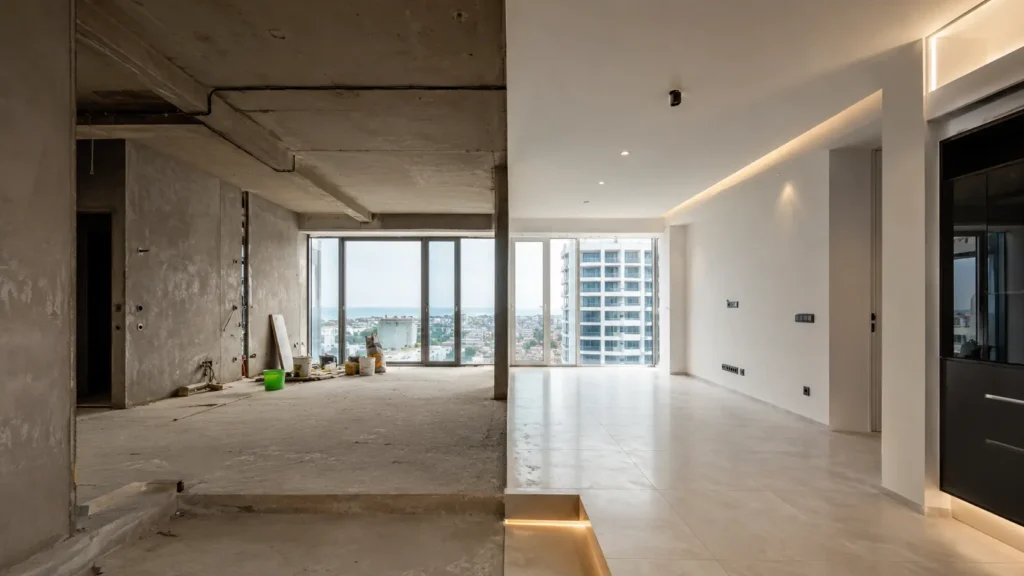
Rough finishing is the mandatory first stage: wall plastering, floor screed, distribution of utility systems throughout the rooms, and waterproofing of wet areas. The cost is 120–180 GEL/m². For a 150 m² house, that’s 18,000–27,000 GEL.
Fine finishing is divided into three price segments. Economy (200–300 GEL/m²) includes wall painting, laying laminate or budget tiles, and installing standard plumbing fixtures and electrical fittings. Comfort (400–600 GEL/m²) — quality flooring, porcelain stoneware cladding for bathrooms and kitchen, stretch ceilings, and more expensive fixtures. Premium (from 800 GEL/m²) — designer finishing, bespoke solutions, and European-brand equipment.
When choosing finishing materials for Batumi, it’s important to account for the humid subtropical climate: R10+ class porcelain stoneware with water absorption below 0.5%, moisture-resistant plasterboard for bathrooms, and anti-corrosion AISI 304 steel fasteners. Using standard materials in Batumi’s 70–85% humidity leads to the need for rework within just 3–5 years. Read more about turnkey finishing and renovation in Batumi on the Realux home page.
| Segment | What’s included | Price | For a house of 150 m² |
|---|---|---|---|
| Rough finishing | Plastering, screed, waterproofing, wiring | 120–180 GEL/m² | 18,000–27,000 GEL |
| Finishing – economy | Paint, laminate, standard plumbing | 200–300 GEL/m² | 30,000–45,000 GEL |
| Cleanliness – comfort | Porcelain tiles, suspended ceilings, high-quality fittings | 400–600 GEL/m² | 60,000–90,000 GEL |
| Clean – premium | Design project, original solutions, brands | From 800 GEL/m² | From 120,000 GEL |
| Logistics on the slope | Delivery of materials, ascent to the terrain | — | +12,000–18,000 GEL |
Hidden Costs: What’s Not Visible in the Basic Estimate
Hidden items on a sloped plot add 25–40% to the main estimate — and these are exactly what most clients fail to budget for when planning. Below is a checklist of costs that almost never appear in construction companies’ initial quotes.
- Terracing of the site – from 150 GEL/m²: mandatory for slopes greater than 15°, creates horizontal platforms for construction and landscaping
- Retaining walls – 200-400 GEL/m²: for slopes over 20°, they are essential; for slopes up to 25°, geogrids (45-70 GEL/m²) are a cheaper alternative.
- Drainage system — 25-35 GEL/running meter: protecting the foundation from rainwater is critical in Batumi with its 2500 mm of precipitation per year
- Landscaping of the site — 15,000-25,000 GEL for 10 acres on a slope versus ~8,000 GEL on a flat site: paths, retaining elements, landscaping taking into account the terrain
- Permits and approvals — 2000-3000 GEL: including fees, support and additional assessments for difficult terrain
- The price increase for slopes over 30° is an additional 25,000 GEL on top of the standard slope estimate.
- Geogrids for slope reinforcement – 45-70 GEL/m²: 30% cheaper than retaining walls, but only applicable for slopes up to 25°
- Additional foundation reinforcement for seismic loads—10-15% of the foundation cost—is a requirement of Georgian standards for houses in Batumi.
The minimum budget for a 120-150 m² house on a slope, taking into account all hidden items, is from 45,000 GEL only for excavation work, foundation, and ensuring the stability of the site, excluding the cost of the frame and finishing.
Final estimate: how much does a 150 m² house cost in Batumi?
Let’s bring all the figures together into one table. We compare two scenarios: a 150 m² house on a flat plot and the same house on a 20° slope. It’s precisely this $70,000 difference that remains invisible to most plot buyers.
| Stage | Flat area | Slope 20° | Difference |
|---|---|---|---|
| Design and permits | $5,000–$7,000 | $8,000–$12,000 | +50–70% |
| Geodesy and geology | $300–$400 | $600–$900 | +50–100% |
| Earthworks | $5,000–$8,000 | $8,000–$14,000 | +60–70% |
| Foundation | $7,000–$10,000 | $13,000–$18,000 | +80–90% |
| Retaining walls / terracing | — | $8,000–$15,000 | New article |
| Box at home | $40,000–$60,000 | $44,000–$66,000 | +5–10% |
| Engineering communications | $3,000–$5,000 | $4,000–$7,000 | +35–40% |
| Rough finishing | $7,000–$10,000 | $8,000–$12,000 | +15–20% |
| Fine finishing (comfort) | $22,000–$33,000 | $26,000–$40,000 | +15–20% |
| Logistics on the slope | — | $4,500–$7,000 | New article |
| Improvement | $3,000–$5,000 | $5,500–$9,000 | +80–90% |
| Total | $120,000–$180,000 | $180,000–$250,000 | +50–70% |
Costs vary significantly by district. In the Old City, construction prices start from $1,200/m² — dense development, limited access for machinery, and the historic zone add 25–30% to the estimate. In Khelvachauri and the suburban districts, prices start from $900/m²: land is cheaper and access is easier, but plot slopes are often above average.
Construction timelines on a slope also increase: while a 150 m² house on a flat plot takes 6–8 months to build, the same volume on a 20° slope takes 8–12 months. The extra time goes to earthworks, the strength-gaining of terraced structures, and logistics.
The exact estimate depends on the specific plot, the chosen materials, and the architectural design. Realux prepares a detailed estimate after a specialist visit and a geodetic survey of the plot — with no hidden items or averaged coefficients. You can find out the cost of building your home through a free consultation on the website.
